![AI Tinkerers Austin: GTM Engineering & Agentic Sales Systems [AI Tinkerers - Austin]](https://sloppy-joe-app.imgix.net/ai_tinkerers/logos/ai_tinkerers_-_austin_laptop-sticker_190_8098a9dce85478fc454aa840ecd1280e.png?w=300&fit=max&auto=format%2Ccompress&q=75)








AI Tinkerers Austin: GTM Engineering & Agentic Sales Systems
Start your RSVP
First, verify your email. Then you'll finish your registration.
Here is the modified markdown with the new banner image integrated as the main header image right below the main title.
Building the Future of GTM
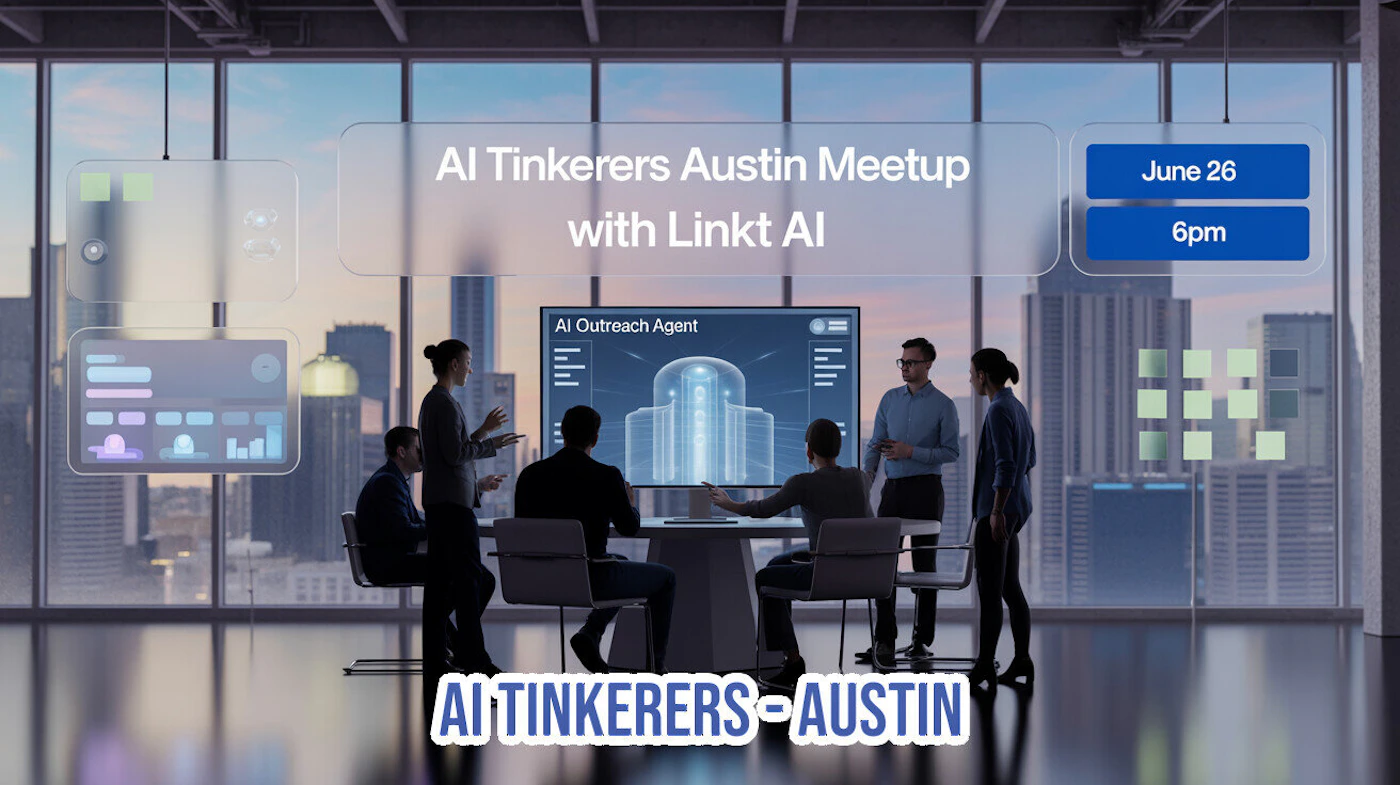
On Friday, June 26, 2026, AI Tinkerers Austin is hosting a technical, code-first meetup focused on the engineering patterns powering the next generation of go-to-market systems.
We are moving past simple API wrappers and basic email automation. The frontier of GTM is defined by autonomous agentic workflows, multi-agent orchestration, and deep integration into CRM and RevOps systems. This event is a practitioner-only gathering designed to show how technical builders are solving the architectural challenges of deploying AI-native sales and marketing systems in production.
Space is strictly limited to 150 active builders to ensure high-signal technical exchange. The exact downtown Austin location will be disclosed to accepted attendees.
Who Should Attend
This event is curated specifically for practitioners who build and deploy systems. We are filtering registrations for:
- GTM & RevOps Engineers: Builders designing custom data pipelines, agentic workflows, and automated pipeline intelligence.
- AI Engineers & Researchers: Developers orchestrating LLMs, building custom agents, and managing context-engineering pipelines.
- Technical Founders & CTOs: Leaders scaling technical sales infrastructure with lean, high-leverage engineering teams.
- Sales Engineers & Solutions Architects: Practitioners implementing complex, human-in-the-loop automation at scale.
📢 Call for Demos: Show Your Stack
We are actively seeking 5-minute technical demos that pop the hood on your current GTM builds. We enforce a strict no slides, no pitches policy—we only want to see running code, system architecture diagrams, and raw terminal outputs.
We want to see your messy experiments, creative hacks, and technical discoveries. Your demo should answer: “How did you build this interesting thing?” not “Why should someone use this product?”
Note: Accepted demo presenters receive priority admission.
🗓️ Event Agenda
- 6:00 PM: Doors Open & Technical Networking
- 6:45 PM: Kickoff & Community Update
- 7:00 PM: Technical Demos (Live code, deep implementation notes, and Q&A)
- 8:15 PM: Science Fair & Peer-to-Peer Technical Exchange
- 9:00 PM: Event Close
Meet Our Sponsors & Hosts
We are incredibly grateful to the organizations making this gathering possible:
- Linkt AI: Partnering to push the boundaries of AI-native sales systems and GTM engineering.
- Lou of CRE-TEAM: Collaborating to connect Austin’s top-tier GTM and sales community leadership.
- AI Tinkerers Austin: Supporting the local ecosystem of active generative AI builders.
Interested in supporting the builder ecosystem? View our sponsorship opportunities.
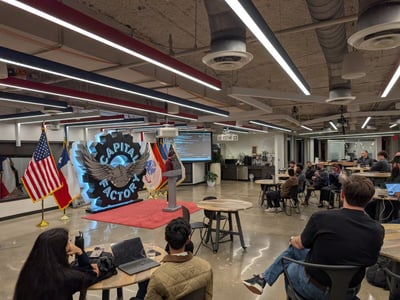
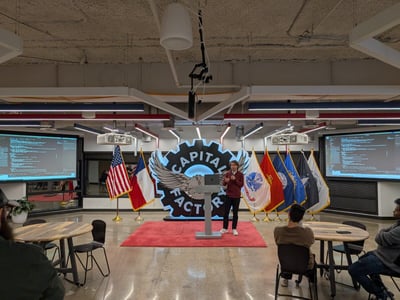
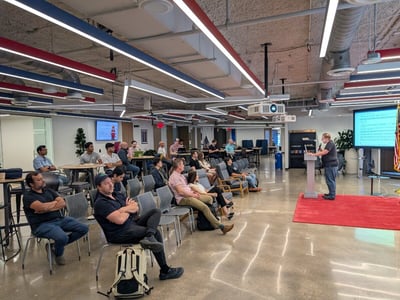
Event photos
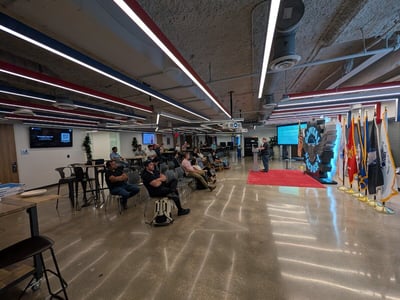
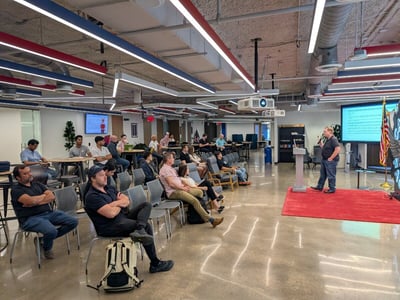
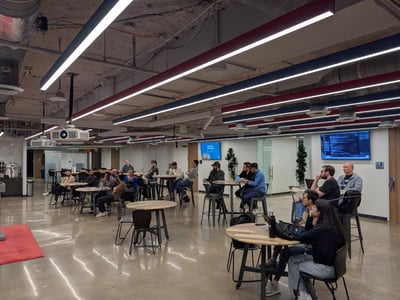
Curation & Community Standards
AI Tinkerers is a community for those actively shipping code. We maintain a high-signal environment by manually screening all applicants for demonstrable technical work. This is not a venue for recruiters, traditional marketers, or high-level consultants. Admission is based entirely on technical merit and active builder status.
📊 AI Tinkerers Austin Stats
- Attendees: This community of 891 technical professionals features a high concentration of AI and machine learning expertise, with 82% specializing in LLMs and RAG. The membership includes senior leaders from Google DeepMind, Tesla, and Amazon. Notable for its focus on agentic workflows and autonomous systems, the group bridges the gap between theoretical research and production-grade AI deployment.
- Companies Represented: AI leaders and engineers from tech giants like Google, Amazon, Microsoft, and Nvidia, alongside teams from xAI, Adobe, Databricks, and Tesla, and emerging startups including Torc Robotics, Comet, ClosedLoop.ai, Loman AI, and more.
- Demos: 43 demos have been submitted and 40 have been presented. The most exciting themes have focused on agentic AI for real workflows, RAG/hybrid search for production-grade retrieval, and LLM engineering practices like eval/optimization, orchestration cost controls, and scalable LMOps. Highlights include Russell Sadrieff’s AI PM workflow, Julian Ghadially’s DSPy optimization experiments, J. Michael Rozmus’s Bedrock RAG chatbot, and Michael Samon’s legislative monitoring system.
- Testimonials:
A great demo (per the strongest-rated examples and the audience’s requested improvements) feels like an interactive system you can follow end-to-end: show the agent’s workflow in action, not just the concept. Aim to turn output into visible artifacts (documents, reports, structured graphs, action execution traces) and make the architecture legible through concrete mechanics (protocols like MCP, measurable optimization results, or specific implementation components). Provide at least one realistic use case that exercises the “frontier” behavior (agent/tool loop, dynamic interface generation, or actionable integrations) and ensure the audience can learn by watching what the system does—this aligns with the form’s emphasis on functional prototypes that move beyond text-based chat into agentic, interactive interfaces. Avoid demos that are primarily high-level descriptions without enough implementation detail or proof-of-function, and avoid relying on the audience to infer the experience—explicitly include a live demonstration or example product/launch scenario and a short example use-case summary to reduce the “so what does it do?” gap noted in feedback.
In Austin, DSPy and Prompt Optimization Experiments by Julian Ghadially was highlighted as “excellent” and “great work” because it shares research-backed experimentation on DSPy prompt optimization applied to a fact-checker, including strong evidence-based framing (measurable performance improvement) and clear modular system components. In Austin, GitKB – A distributed knowledge base protocol for agentic engineering at global scale by Matt Walters stands out because the audience strongly endorses the concept’s practical architecture: it’s a local-first, git-like knowledge graph protocol with sparse sync semantics, and the talk justifies why that matters for agentic coding velocity. In Austin, ClawForce: Let Claude Spawn People to Do Things at Scale by Mike Angstadt is liked for enabling physical-world workflows from an AI agent via MCP-based orchestration and gig-economy “human provisioning,” with the demo centered on simple one-line commands that “just show up” as real-world actions and measurable proof-of-work examples. Finally, in Austin, Building AI Product Manager. Using AI to help PMs move faster and enable engineers/founders to do product work like a pro. by Russell Sadrieff received a perfect rating, and while the only explicit feedback called for more live demonstration/use-case depth, the praise itself implies attendees valued the operational “quality standards” framing and the fact that the speaker built the app from scratch and can talk through the building process and the intended product workflow.