![September Meetup: 3D Perception for Robotics Theme [AI Tinkerers - Austin]](https://sloppy-joe-app.imgix.net/ai_tinkerers/logos/ai_tinkerers_-_austin_laptop-sticker_190_8098a9dce85478fc454aa840ecd1280e.png?w=300&fit=max&auto=format%2Ccompress&q=75)





September Meetup: 3D Perception for Robotics Theme
Directions
Event Ended
This event has already taken place.


Join us for our September AI Tinkerers meetup in Austin, where we’ll showcase the latest innovations and experiments from our community of active builders and practitioners in AI and large language models (LLMs). This month’s theme is 3D Perception for Robotics!
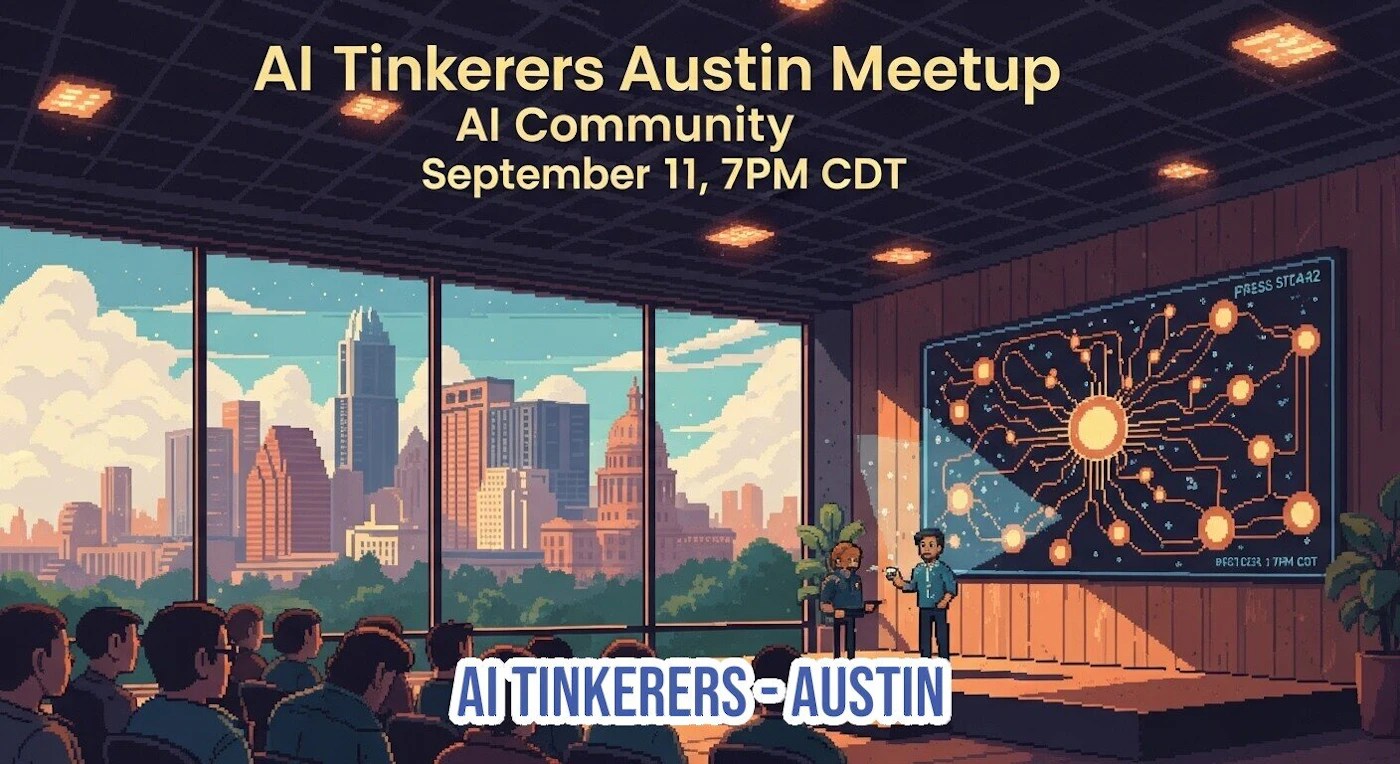
Date: Thursday, September 11th, 2025
Time: 7:00 PM - 9:00 PM
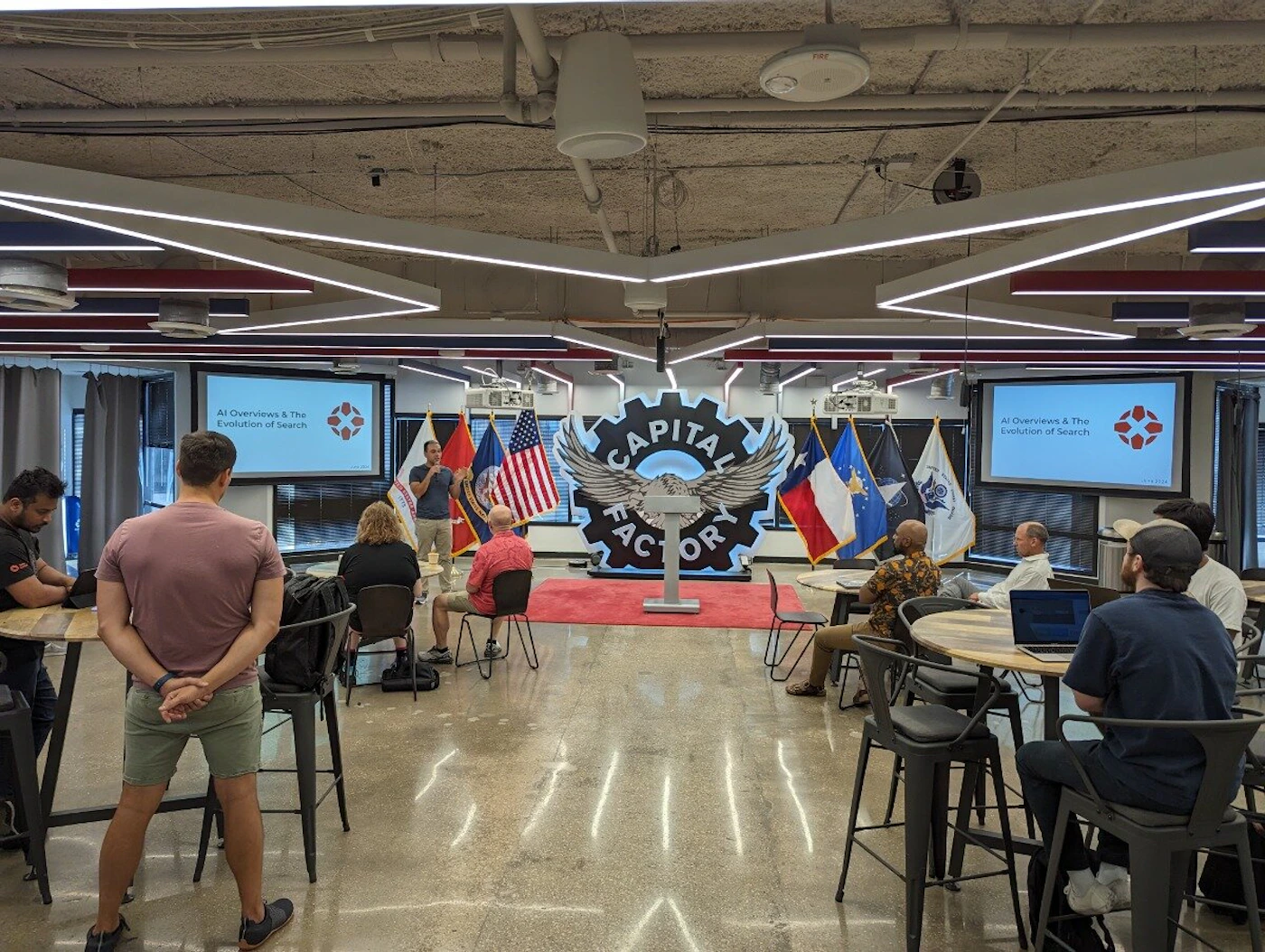
Location: Voltron Room, Capital Factory, Downtown Austin, TX
Event Highlights
- Community Demos: Witness cutting-edge projects and experiments from fellow Tinkerers
- Networking: Connect with like-minded AI practitioners and builders
- Technical Discussions: Dive deep into real-world challenges and solutions
- 3D Perception for Robotics: Explore advances in depth sensing, point clouds, SLAM/VIO, mapping, calibration, tracking, and multi-sensor fusion for robots
What is the 3D Perception theme?
3D perception is how robots understand the world in three dimensions using sensors like LiDAR, depth cameras, and stereo/mono RGB. We’ll cover topics such as sensor fusion (camera-LiDAR-IMU), BEV representations, point-cloud learning, scene reconstruction (NeRF/3DGS), localization and mapping (SLAM), calibration, and evaluation/benchmarking on real datasets. Expect hands-on conversations about algorithms, datasets, ROS 2 integrations, and deployment on edge hardware.
Who Should Attend?
This meetup is exclusively for practitioners actively building AI/robotics systems—people shipping perception stacks, experimenting with 3D computer vision, or integrating foundation models with embodied agents. If you’re hands-on with LLM-enabled apps and/or robotics perception pipelines, you’ll fit right in.
AI Tinkerers is not for those looking to enter the field, people marketing services, or investors scouting deals. We curate for active builders to foster trust, transparency, and collaboration.
Demo Submissions
Interested in showcasing your work? We’re seeking technical demos of novel projects related to 3D perception/robotics (e.g., SLAM, mapping, sensor fusion, BEV, NeRF/3DGS, calibration, on-robot deployment).
Your demo should be ~5 minutes and jump straight into the tech—no pitches or slides; just code, logs, terminals, and robots.
To apply for a demo slot, please register for the event and then submit your proposal through the demo submission form.
👑 Sponsor
Capital Factory is the center of gravity for entrepreneurs in Texas. They meet the best entrepreneurs in Texas and introduce them to their first investors, employees, mentors, and customers. They also sponsor the AI Tinkerers Austin Chapter.

Event Stats
This community of 891 technical professionals features a high concentration of AI and machine learning expertise, with 82% specializing in LLMs and RAG. The membership includes senior leaders from Google DeepMind, Tesla, and Amazon. Notable for its focus on agentic workflows and autonomous systems, the group bridges the gap between theoretical research and production-grade AI deployment.
AI leaders and engineers from tech giants like Google, Amazon, Microsoft, and Nvidia, alongside teams from xAI, Adobe, Databricks, and Tesla, and emerging startups including Torc Robotics, Comet, ClosedLoop.ai, Loman AI, and more.
43 demos have been submitted and 40 have been presented. The most exciting themes have focused on agentic AI for real workflows, RAG/hybrid search for production-grade retrieval, and LLM engineering practices like eval/optimization, orchestration cost controls, and scalable LMOps. Highlights include Russell Sadrieff’s AI PM workflow, Julian Ghadially’s DSPy optimization experiments, J. Michael Rozmus’s Bedrock RAG chatbot, and Michael Samon’s legislative monitoring system.
Testimonials from Previous Meetups
Showcase of Previous Demos
A great demo (per the strongest-rated examples and the audience’s requested improvements) feels like an interactive system you can follow end-to-end: show the agent’s workflow in action, not just the concept. Aim to turn output into visible artifacts (documents, reports, structured graphs, action execution traces) and make the architecture legible through concrete mechanics (protocols like MCP, measurable optimization results, or specific implementation components). Provide at least one realistic use case that exercises the “frontier” behavior (agent/tool loop, dynamic interface generation, or actionable integrations) and ensure the audience can learn by watching what the system does—this aligns with the form’s emphasis on functional prototypes that move beyond text-based chat into agentic, interactive interfaces. Avoid demos that are primarily high-level descriptions without enough implementation detail or proof-of-function, and avoid relying on the audience to infer the experience—explicitly include a live demonstration or example product/launch scenario and a short example use-case summary to reduce the “so what does it do?” gap noted in feedback.
In Austin, DSPy and Prompt Optimization Experiments by Julian Ghadially was highlighted as “excellent” and “great work” because it shares research-backed experimentation on DSPy prompt optimization applied to a fact-checker, including strong evidence-based framing (measurable performance improvement) and clear modular system components. In Austin, GitKB – A distributed knowledge base protocol for agentic engineering at global scale by Matt Walters stands out because the audience strongly endorses the concept’s practical architecture: it’s a local-first, git-like knowledge graph protocol with sparse sync semantics, and the talk justifies why that matters for agentic coding velocity. In Austin, ClawForce: Let Claude Spawn People to Do Things at Scale by Mike Angstadt is liked for enabling physical-world workflows from an AI agent via MCP-based orchestration and gig-economy “human provisioning,” with the demo centered on simple one-line commands that “just show up” as real-world actions and measurable proof-of-work examples. Finally, in Austin, Building AI Product Manager. Using AI to help PMs move faster and enable engineers/founders to do product work like a pro. by Russell Sadrieff received a perfect rating, and while the only explicit feedback called for more live demonstration/use-case depth, the praise itself implies attendees valued the operational “quality standards” framing and the fact that the speaker built the app from scratch and can talk through the building process and the intended product workflow.
RSVP with the form above now!
Spaces are limited and we curate attendees to ensure a high-quality experience. Fill out your profile with detailed information and include social links to help you stand out to the organizers.
AI Tinkerers is about active collaboration, experimentation, and pushing the boundaries of what’s possible with AI and robotics. We look forward to seeing you—and your groundbreaking work!